
Seeing Red Trees?
Maine Department of Agriculture, Conservation and Forestry sent this bulletin at 10/23/2026 08:55 AM EDT
View as a webpage / ShareMaine Forest Service Spruce and fir trees that turn reddish brown in summer may be showing signs of feeding damage from the native spruce budworm. The caterpillars primarily eat developing buds and needles of spruce and fir, causing the damaged foliage to die and turn reddish brown. In communities around Fort Kent, spruce budworm has caused extensive defoliation in recent years, raising concerns about forest health and long-term impacts. 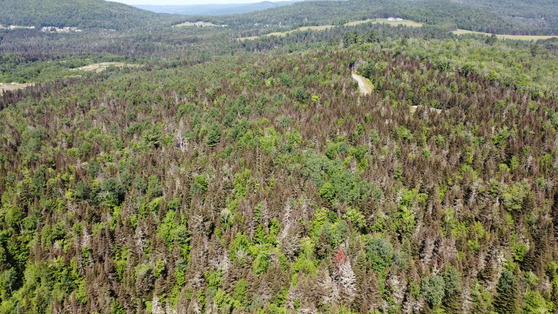 Spruce-fir trees in Fort Kent with reddish-brown needles from spruce budworm defoliation in 2025. Image: E. Deschene, Maine Forest Service.Spruce budworm is always present in Maine’s forests, but populations can occasionally overwhelm their natural enemies and build to outbreak levels. Repeated heavy feeding can cause a significant decline of spruce and fir trees and may eventually lead to tree mortality. Dead and declining trees are more than just a change in color. Healthy trees can withstand stressors such as drought, disease, and insect damage. Widespread spruce budworm outbreaks can alter this balance, affecting wildlife habitat, forest resources, and the Maine communities that depend on healthy forests.A management approach that includes small woodlotsSpruce budworm populations are tracked by washing out and counting the small second-instar caterpillars (L2) from collected tree branches. These L2 counts approximate population density and show where spruce budworm populations are growing and poised to reach outbreak levels.To help maintain the health and resilience of Maine’s forests, the Early Intervention Strategy (EIS) uses targeted aerial insecticide applications in woodlands with rising spruce budworm populations to prevent an outbreak. When EIS reduces budworm populations, natural enemies of spruce budworm can keep them low and stable, maintaining forest health.In 2026, 38 owners of small woodlands participated in EIS management with 127 woodlots enrolled. Another 62,249 acres were treated on large woodland ownerships and public lands across Northern Aroostook County.Early results are encouragingThe goal of EIS isn’t to eliminate spruce budworm – success in the EIS approach across the landscape is defined as stabilized budworm populations, reduced host damage, and the presence of natural enemies helping keep populations in check. In treated areas, post-treatment monitoring samples documented a ~90% reduction in spruce budworm populations. In both treated and untreated areas, evidence of spruce budworm mortality from parasitoids, insect natural enemies of spruce budworm, was also documented. Fewer budworm caterpillars across the landscape meant fewer caterpillars feeding on host foliage throughout the season. As a result, spruce and fir trees remained green this summer.Don’t see red in your woodlot!The Maine Forest Service is organizing another voluntary EIS program for small woodland owners in areas with rising spruce budworm populations in 2027. Landowners with spruce-fir woodlots in Northern Aroostook County may qualify to enroll their forests in the EIS program for free and are invited to submit a landowner interest form with information about the woodlots they would like considered for inclusion.We encourage landowners to talk to their neighbors with adjoining woods that may also be eligible for treatments. Encourage them to submit a landowner interest form before December by going to the Maine Forest Service website at www.maine.gov/sbw. Maine Forest Service District Foresters and Forest Health staff can also provide free woodlot visits if you have further questions.Spruce budworm outbreaks are regional. Given the populations in the region, we expect several more years of potential damage from feeding budworm larvae. Early intervention can prevent budworm health impacts on your forest. Join the effort to prevent a larger outbreak of this pest and fill out the landowner interest form today!Complete the FormInterest forms are due by 12/1/26.Maine State Government is an equal opportunity provider and employer. Manage Preferences | Unsubscribe | Help | Credits | Contact Us |
Subscribe to updates from Maine Department of Agriculture, Conservation and Forestry
Email Address
e.g. name@example.com
Share Bulletin


