
Contribute to Invasive Pest Surveys!
Maine Department of Agriculture, Conservation and Forestry sent this bulletin at 10/06/2026 04:11 PM EDT
View as a webpage / ShareInvasive Pest Outreach InformationWelcome Fall! Fall is an excellent time to be outside and observe nature. For instance, if you are not sure what an ash tree looks like, notice the trees that have started shedding their leaves. Ash trees are usually the first trees in fall to drop leaves (and the last trees in spring to put out leaves). By knowing which trees are ash trees, you may be able to observe early signs of an emerald ash borer infestation. Other invasive pests can be observed at this time of year as well. Whether you are walking through the woods, hiking up a trail, strolling through a town, or fishing by a river, stay alert to your surroundings and you may notice signs of harmful pests. Let us know if you see any!Spotted LanternflyTree of HeavenBig Slimy SlugsEmerald Ash BorerOctober is Firewood MonthSpotted LanternflyWHERE TO LOOK: on grape vines, black walnut, tree of heaven, red maple, and vehicles from other states. 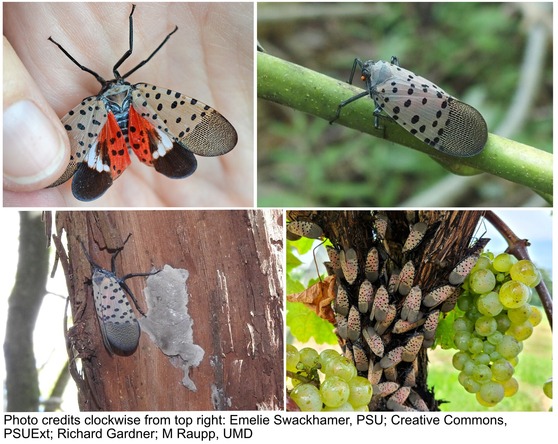 Adult spotted lanternflies and egg massSpotted lanternfly (SLF) is a large planthopper that has been in the U.S. since 2014, when it was first found in Pennsylvania. It has since spread to about 20 states. It is not known to be established in Maine.The spotted lanternfly has proven to be a serious pest of grapevines and other high-value crops such as hops and maple. SLF injures woody plants by piercing the wood and sucking out sap. It exudes honeydew, a sticky sugary substance that attracts yellow jackets and sooty mold. Its preferred host, tree-of-heaven (Ailanthus altissima), is loaded with spotted lanternfly adults this time of year. Luckily for Maine, tree-of-heaven is not commonly found here. But SLF would also be seen feeding on grapevines and black walnut right now. In states south of us, adults are starting to lay egg masses.We are not aware of any overwintering populations of spotted lanternfly in Maine, but you may see adults, which can hitchhike long distances. We are particularly concerned during egg-laying season (October-December) as eggs are laid on a variety of surfaces including nursery stock, vehicles, trailers, lawn furniture, etc. SLF egg masses can be seen until the following spring. If you travel to Maine from another state east of the Mississippi, destroy any SLF adults and egg masses on your vehicle and any other outdoor item you are moving. If you suspect you have seen spotted lanternfly in Maine, take lots of photos, note the location, and report it.Tree of HeavenWHERE TO LOOK: along rail lines, roadsides, urban areas, disturbed sites 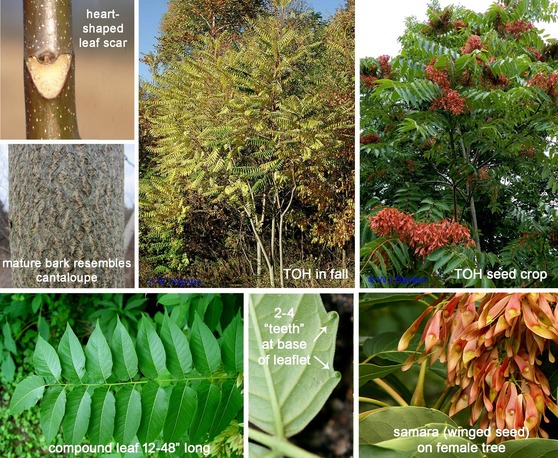 Features of the invasive tree-of-heaven (Ailanthus altissima)Tree-of-Heaven (TOH) is an invasive plant in the U.S. and also a favored host of the spotted lanternfly mentioned above. Tree-of-heaven is commonly found in disturbed areas where it easily outcompetes native plant species. It is widespread throughout the mid-Atlantic states and southern New England, but its distribution in Maine is known to be rare and spotty. Knowing the distribution of TOH may help us locate high-risk areas for spotted lanternfly establishment.Tree-of-heaven looks a lot like sumac and black walnut. Sumac is very common in Maine. This factsheet helps to highlight the differences between TOH and its lookalikes.If you suspect you have seen tree-of-heaven in Maine, take lots of photos, note the location, and, send a report.Big Slimy SlugsWHERE TO LOOK: gardens, woodlands, disturbed sites 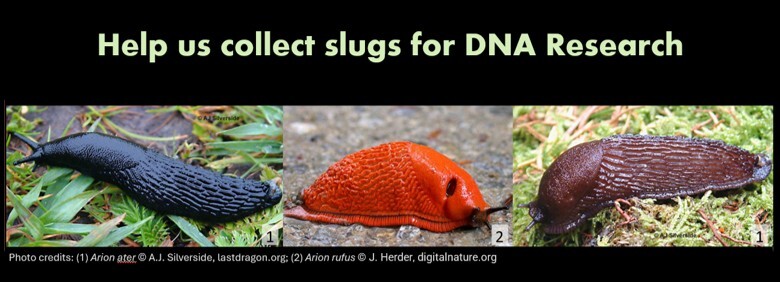 Color variations of the Arion ater complex.Over the years, we have been alerted to a smattering of communities of non-native slugs. Some are large, slimy, and black; some are large, slimy, and brown. Neither community appears to be particularly pestiferous, but researchers would love to figure out how these communities may be related to each other and to other slugs found in other states.We have been asked to collect and submit Arion ater-type slugs (pictured) from different locations in Maine for DNA testing. The knowledge gained from this testing would not only help researchers identify the origin of these slugs but also help them understand how long they may have been here and how they could have spread. Genetic testing can also improve the identification of closely related slug species that are difficult to distinguish based solely on appearance, particularly when individuals are young.If you notice any large slugs, longer than 2.5 inches, uniform in color, and contract when disturbed (see images), please take a photo and contain it*. Contact us at bugwatch@maine.gov and we will come by and collect it.* try not to handle slugs with bare hands. They can transmit illness-causing parasites. Use gloves, tongs, sticks, or another object to put the slug in a container. Wash your hands well.Emerald Ash BorerWHERE TO LOOK: on ash trees – in the woods, along trails, near rivers, in town 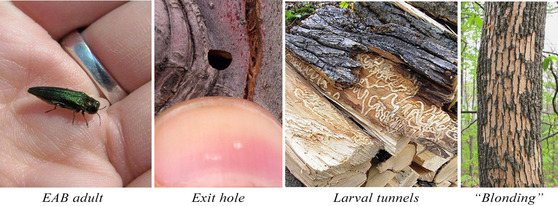 Emerald ash borer and features of infestation in ash trees.Emerald ash borer (EAB) is a small invasive beetle that attacks and kills ash trees. It was discovered in Maine in 2018 at opposite ends of the state (Aroostook and York counties), but it has since spread to 13 of 16 counties. Movement of infested wood, including firewood, is responsible for the rapid spread.Now is a great time to notice signs of its presence. On ash trees, look for woodpecker activity (“blonding”), bark splitting, S-shaped tunnels under the bark, and D-shaped exit holes. If you are not sure what an ash tree looks like, here is a handy video.Learn more about EAB in Maine, and report suspicious sightings if observed in towns where EAB has not been found.October is Firewood MonthOctober is nationally known as Firewood Month. As fall camping, hunting seasons, and winter home‑heating get underway, the U.S. Department of Agriculture’s Animal and Plant Health Inspection Service (APHIS) and the Maine Department of Agriculture, Conservation and Forestry are urging everyone to make safe firewood choices that help prevent the spread of invasive forest pests. 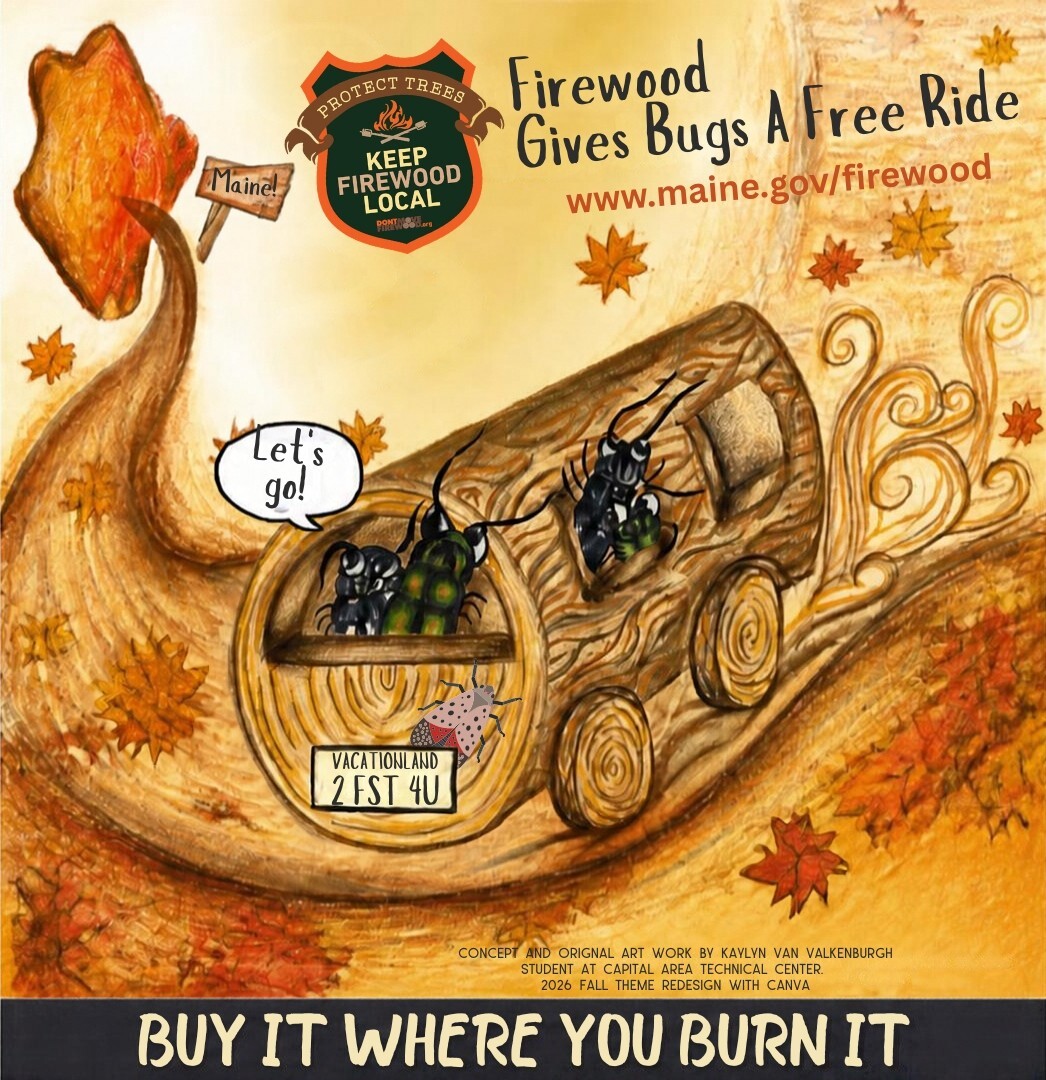 Untreated out-of-state firewood is banned in Maine and even in-state firewood can spread pests to new areas.Maine forests are threatened by many exotic pests and diseases that hitchhike on firewood, including emerald ash borer, spotted lanternfly, oak wilt disease, Asian longhorned beetle, browntail moth, and beech leaf-mining weevil. The movement of firewood speeds up the spread of destructive forest pests. For example, about three-quarters of the early infestations of emerald ash borer in Michigan were directly tied to firewood transport. Some domestic spread of the invasive Asian longhorned beetle has also been traced to the movement of infested firewood.To help protect the health of our forests, follow these firewood tips:Use local firewood (50 miles is too far, 10 miles or less is best), orUse certified heat-treated firewood (heat-treated to 160 degrees Fahrenheit for at least 75 minutes, andFollow quarantine requirements (firewood is a regulated article in the emerald ash borer quarantine in Maine)Help prevent the spread of insects and diseases that harm our forests by choosing heat-treated or local firewood. Find more tips at maine.gov/firewood.Learn more about the risks of firewood and other initiatives at Don’tMoveFirewood.OrgMaine State Government is an equal opportunity provider and employer. Manage Preferences & Unsubscribe | Help | Credits | Contact Us |
Subscribe to updates from Maine Department of Agriculture, Conservation and Forestry
Email Address
e.g. name@example.com
Share Bulletin


